
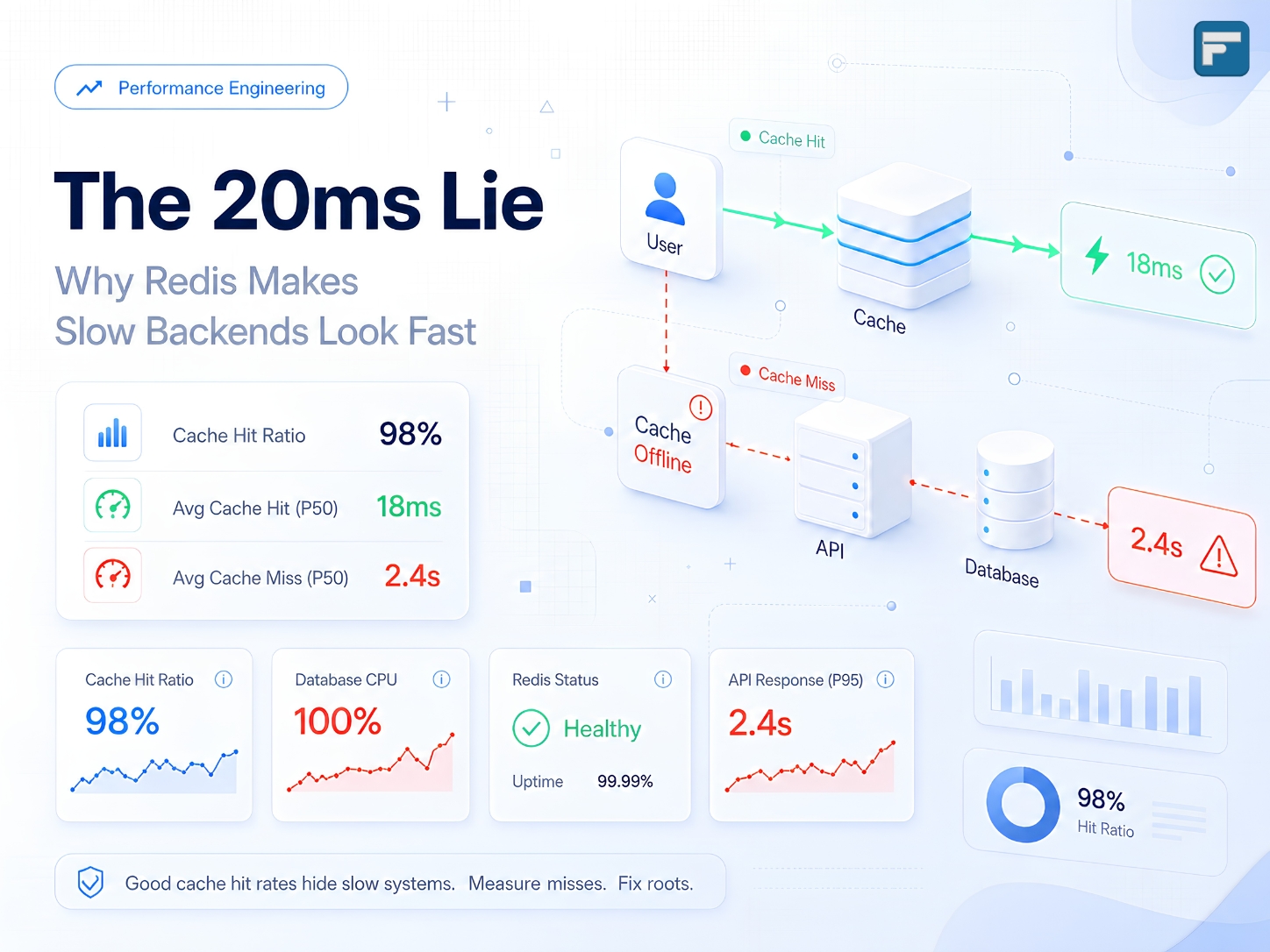
It’s Friday. Everything Looks Perfect.
Your monitoring dashboard looks amazing.
🟢 System Status

API Response Time
18ms

Database CPU
12%

Redis
Healthy

Error Rate
0.01%

Everyone is Happy 🙂
Your manager smiles.
The client is impressed.
The product team is celebrating another successful release.
You proudly tell everyone,
“Our APIs respond in under 20 milliseconds.”
Life is good.
Then…
Saturday • 2:17 AM
Without warning…
Redis restarts.
❌ Redis Restarted

↓

API Response
2.4 Seconds

↓

Database CPU
100%

↓

Connection Pool Exhausted

↓

Timeouts

↓

Users Can't Login

↓

Production Down 🚨
Slack explodes.
Your phone won’t stop ringing.
PagerDuty wakes you up.
The CEO asks,
“What changed?”
Nothing.
No deployment.
No database migration.
No code changes.
No infrastructure updates.
Only one thing disappeared.
The cache.
And suddenly…
Everyone discovers the backend was never fast.
It was simply borrowing speed from Redis.
The 20ms Lie
Imagine opening your dashboard.
Average API Response

18ms
Amazing.
Customers love it.
Monitoring tools love it.
Everyone thinks the backend has been optimized.
But here’s the uncomfortable truth.
18ms isn’t your backend’s performance.
It’s your cache hit.
Your real backend is still taking
2 Seconds

or

3 Seconds

or even longer...
The expensive work never disappeared.
Users just stopped reaching it because repeated reads were being served from the cache. This is exactly how the cache-aside pattern works: on a cache hit, the application returns cached data without querying the database.
The Biggest Myth About Redis
Many developers think this is what happens.
Slow API

↓

Add Redis

↓

Fast API

↓

Problem Solved ✅
That’s not what happened.
This is what actually happened.
Slow Query

↓

Store Result in Redis

↓

Future Requests Skip Database
Your SQL query is still slow.
Your joins are still expensive.
Your indexes are still missing.
Redis simply prevented users from noticing.
Caching improves repeated read performance by avoiding unnecessary trips to the database, but it doesn’t make inefficient queries execute faster.
Imagine Two Worlds
Without Cache
User

↓

API

↓

Authentication

↓

Database

↓

Complex Query

↓

2 Seconds
Every request does real work.
With Cache
User

↓

Redis

↓

18ms
Looks incredible.
Until…
Cache Miss

↓

API

↓

Database

↓

2 Seconds Again
Nothing became faster.
The expensive query simply came back.
What Cache Quietly Hides
Caching is often blamed for nothing.
The real issue is usually underneath it.
1. Missing Database Indexes
Imagine this query.
SELECT *
FROM Orders
WHERE customer_id = 1284;
Without an index,
your database scans millions of rows.
Instead of fixing the index…
someone caches the response.
Problem hidden.
Not solved.
2. N+1 Queries
You request one user.
The backend performs
1 Query

↓

100 More Queries

↓

100 Database Calls
Redis makes the second request fast.
The N+1 problem still exists.
3. Bad Database Design
Huge joins.
Repeated calculations.
Unnecessary relationships.
Poor normalization.
Instead of redesigning the schema…
developers cache everything.
4. Heavy Business Logic
Imagine one API endpoint.
Authenticate User

↓

Load Orders

↓

Load Products

↓

Calculate Revenue

↓

Call Payment Service

↓

Call Analytics Service

↓

Generate Report
Execution Time
2.8 SecondsAdd Redis.
Now users see
25msDid the logic become efficient?
No.
Users simply stopped executing it.
5. Slow External APIs
Your backend depends on
Maps API

↓

Payment Gateway

↓

CRM

↓

Shipping Service
Instead of reducing unnecessary requests,
responses are cached.
Everything looks healthy…
until the cache expires.
Then Production Traffic Arrives
Everything works beautifully.
Until one key expires.
Now imagine
50,000 Users

↓

Cache Expires

↓

Everyone Requests Same Data

↓

Every Request Hits Database

↓

CPU 100%

↓

Connections Exhausted

↓

Timeouts

↓

Production Outage
This is called a cache stampede—many requests regenerate the same expired cache entry simultaneously, overwhelming the backend. Preventing this often requires locking, stale-while-revalidate, or request coalescing strategies.
Cache Creates New Problems Too
People think caching is simple.
Install Redis

↓

Done
Reality is different.
Now you must manage
- Cache Invalidation
- TTL Expiration
- Stale Data
- Cache Warming
- Memory Eviction
- Cache Stampede Protection
- Distributed Consistency
- Cold Starts
- Monitoring Hit Ratio
Caching makes systems faster,
but also more complex.
When Cache Is Actually the Right Solution
Caching is not bad.
It is one of the best optimization techniques available.
Use it for
✅ Product Catalogs
✅ Country Lists
✅ Exchange Rates
✅ Feature Flags
✅ Configuration
✅ Static Assets
✅ Frequently Read Reports
These are read-heavy workloads where caching shines.
What You Should Never Use Cache To Hide
❌ Missing Indexes
❌ Bad SQL
❌ N+1 Queries
❌ Poor Schema Design
❌ Slow Algorithms
❌ Too Many API Calls
❌ Inefficient Business Logic
Before You Add Redis…
Ask yourself.
✔ Have I profiled this endpoint?
✔ Is my SQL optimized?
✔ Are proper indexes present?
✔ Can I reduce joins?
✔ Am I making unnecessary queries?
✔ Can I batch requests?
✔ Is the bottleneck actually the database?
✔ Have I measured before and after?
If the answer is No…
Don’t add Redis yet.
Fix the backend first.
Final Thought
A great backend becomes faster with caching.
A poorly designed backend becomes dependent on caching.
If your application collapses the moment Redis goes offline…
Redis wasn’t your optimization.
It was your life support.
💬 What do you think?
Have you ever fixed a “performance issue” by adding Redis… only to discover later that the real bottleneck was a missing index, an N+1 query, or an inefficient design?
Share your experience below. Let’s learn from real production stories.