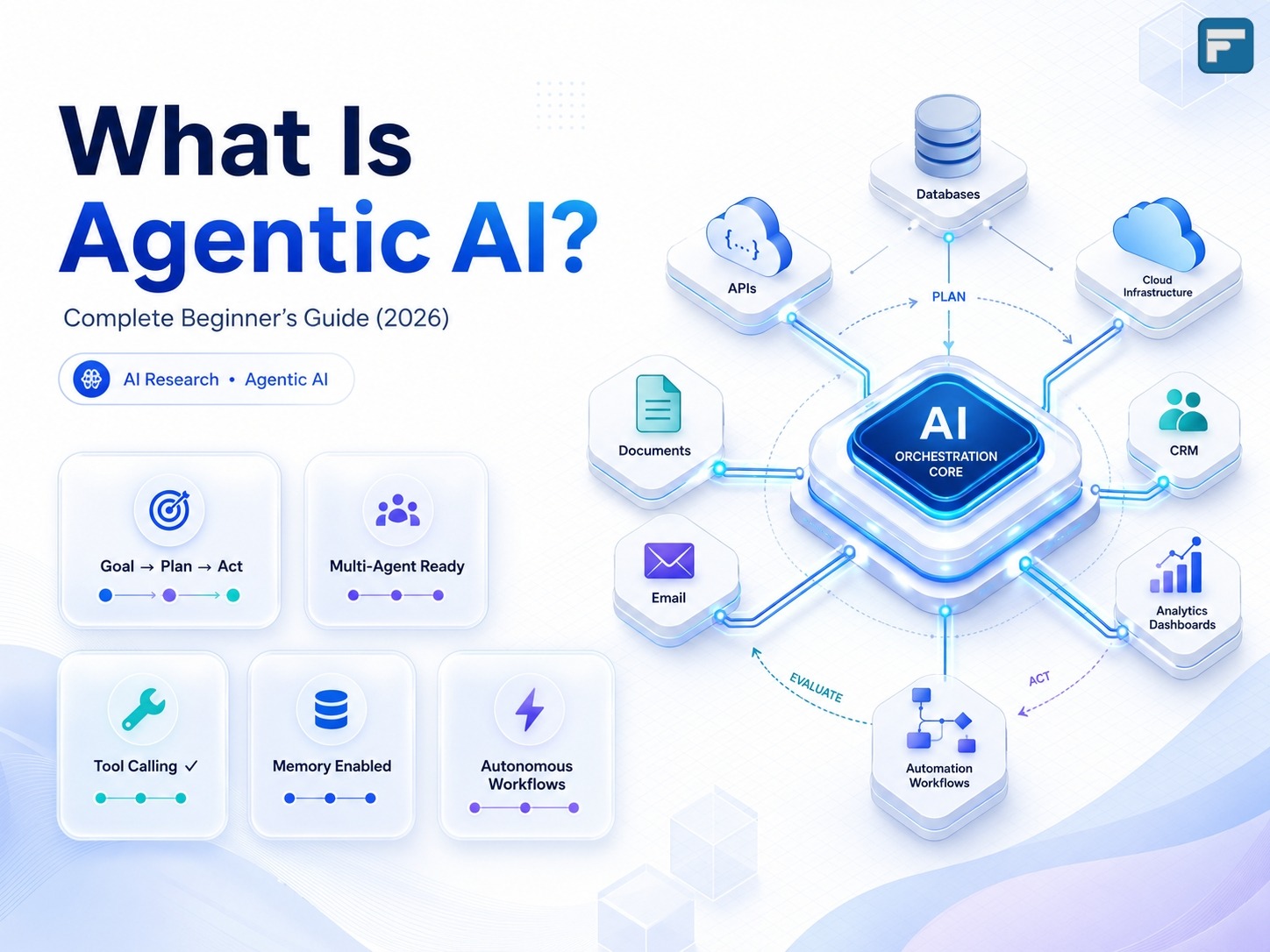
Agentic AI is the shift from “AI that responds” to “AI that actually does work for you end‑to‑end.” Instead of just chatting or generating text, agentic systems can understand a goal, plan the steps, call tools and APIs, and iteratively improve their own output with minimal human supervision.
This guide is written for 2026, when agentic AI has moved from hype to real adoption in enterprises, startups, and IT service companies especially those building workflow automation, copilots, and intelligent products for clients.
Traditional Generative AI (like classic chatbots) mainly:
- Responds to prompts
- Generates text, code, or images
- Has no long‑term memory or task management
Agentic AI goes further and treats the model as a “brain with hands”:
- Understands objectives instead of single prompts
- Plans multi‑step workflows
- Uses tools (APIs, databases, scripts)
- Remembers context and past actions
- Monitors, evaluates, and corrects itself over time
In practice, that means an agent can take “Create a weekly marketing report” and independently gather data, clean it, generate insights, and email a formatted report without someone manually triggering each step.
Core Capabilities of Agentic AI
Most agentic systems share a common set of capabilities:
- Perception: Reading text, logs, emails, documentation, or structured data and turning it into machine‑usable context.
- Reasoning: Breaking down goals into sub‑tasks, choosing strategies, and handling edge cases instead of just producing one‑shot output.
- Planning: Creating and updating a step‑by‑step plan for complex tasks (for example, “scrape leads → enrich → score → push to CRM”).
- Action: Calling APIs, running scripts, triggering workflows in tools like CRM, ERP, ticketing systems, or cloud services.
- Memory: Storing results, decisions, and user preferences to improve future runs and maintain continuity across sessions.
- Self‑evaluation: Checking outputs against constraints, logs, or metrics and re‑running parts of a workflow if quality is poor.
For IT companies, these capabilities mean agents can sit inside existing systems and act as “smart digital workers” rather than passive assistants.
Several trends have converged to make 2026 the breakout year for agentic AI:
- Mature LLMs and tools: Modern models now support tool calling, long‑context windows, and reliable multi‑step reasoning, which are prerequisites for robust agents.
- Enterprise demand for automation: Organizations want automation that is flexible, not just rule‑based, especially in operations, support, and analytics.
- Agent frameworks and protocols: Frameworks like LangGraph, CrewAI, AutoGen, and protocols such as Model Context Protocol (MCP) and Agent‑to‑Agent (A2A) have made it easier to design and orchestrate complex agent workflows.
- Clear business ROI: Early adopters report significant productivity gains from “autonomous digital workers” in areas like customer support, finance operations, and IT service delivery.
Market analyses estimate the agentic AI segment growing from single‑digit billions in the mid‑2020s to tens of billions by 2030, driven largely by enterprise adoption of autonomous agents and workflows
Agentic AI vs Traditional Automation
Here’s how agentic AI compares to older automation approaches:
| Aspect | Traditional RPA / Scripts | Agentic AI Agents |
| Input | Fixed rules, structured triggers | Natural language goals plus data, logs, events |
| Flexibility | Brittle; fails when structure changes | Adapts to new formats, instructions, and edge cases using reasoning |
| Logic | Deterministic if/else flows | Probabilistic reasoning plus explicit planning and correction loops |
| Tools | Limited to predefined scripts and connectors | Uses APIs, databases, external tools via tool calling and MCP/A2A |
| Maintenance | High effort when processes change | Agents can be updated via prompts, policies, and small code changes |
| Output Quality | Depends entirely on initial rules | Can review, self‑evaluate, and retry tasks for better outcomes |
For an IT services company, the main advantage is that agentic AI can handle “messy” real‑world workflows that change frequently, instead of requiring rigid process definitions.
Typical Agentic AI Use Cases for IT Companies
By 2026, some of the most common agentic AI use cases include:
- Customer support copilots
Agents triage tickets, suggest responses, update CRM records, and escalate complex cases automatically while keeping humans in the loop. - IT operations and DevOps
Agents monitor logs, detect anomalies, propose remediation steps, create Jira issues, and even execute safe runbooks on cloud platforms. - Business workflow automation
Agentic workflows orchestrate tasks across email, calendars, CRMs, ERPs, and collaboration tools—such as lead scraping, enrichment, scoring, and outreach. - Data and analytics assistants
Agents pull data from warehouses, clean it, run analyses, and generate dashboards or summary reports for business teams. - Knowledge copilots and RAG agents
Retrieval‑Augmented Generation (RAG) agents interact with enterprise knowledge bases, policies, and documentation to answer complex, company‑specific questions.
These use cases are especially relevant for IT companies in consulting, managed services, and product development, where agentic AI becomes a competitive differentiator.
Key Building Blocks: Architecture of an AI Agent
While implementations differ, most modern agents follow a similar architecture:
- Goal and instructions layer
- System prompts, policies, and constraints define what the agent can and cannot do.
- Business rules and safety guidelines live here, often configurable per client or project.
- Planner
- Takes a high‑level objective and breaks it into ordered sub‑tasks.
- Can re‑plan dynamically when a step fails or new information appears.
- Executor / Tool layer
- Connects to APIs, databases, SaaS tools, internal services, and scripts.
- Uses frameworks like LangChain or LangGraph for tool routing and orchestration.
- Memory and context store
- Short‑term memory to track the current workflow.
- Long‑term memory (often in vector databases) to recall past interactions and data.
- Evaluation and monitoring
- Quality checks, logging, metrics, and human‑in‑the‑loop review.
- AgentOps practices ensure reliability, safety, and observability.
For software engineers, this architecture feels familiar similar to microservices and workflow engines, but with LLMs at the heart of perception and decision‑making.
Single‑Agent vs Multi‑Agent Systems
Not all agentic AI systems are the same. Two common patterns are:
- Single agent
- One generalist agent handles an entire workflow.
- Easier to build and deploy, suitable for simpler use cases like document processing or ticket triage.
- Multi‑agent systems
- Multiple specialized agents collaborate: for example, “Research Agent,” “Data Agent,” “Reviewer Agent,” and “Deployment Agent.”
- Orchestrated using frameworks and protocols, enabling division of labor and complex workflows.
Multi‑agent architectures require good governance, logging, and clear responsibility boundaries to avoid chaos and unexpected behavior.
How Agentic AI Fits Into Your Stack
For an IT company, agentic AI usually sits on top of existing infrastructure instead of replacing it:
- Integrates with existing SaaS: CRM, ERP, ticketing, CI/CD, cloud platforms, communication tools.
- Wraps around APIs and scripts: Agents call your existing services instead of reinventing them.
- Coexists with RPA and workflow tools: LLM‑driven agents can decide when to trigger deterministic bots or pipelines.
- Uses standard observability: Logs, traces, dashboards, and alerts monitor agent decisions and performance.
This layered approach allows gradual adoption: start with one agent embedded in a single workflow, measure impact, then expand to multi‑agent orchestrations.
Learning Path: How Beginners Get Into Agentic AI (2026)
If your team is new to agentic AI, current best practices suggest a staged learning path:
- Understand foundations
- Difference between traditional LLM apps and full agents.
- Core concepts: memory, planning, action loops, safety.
- Experiment with no‑code / low‑code agents
- Use tools that let you build simple agents and workflows without heavy coding.
- Good for rapid prototyping and internal demos.
- Learn Python and API‑based development
- Build agent backends with Python, FastAPI, and REST APIs.
- Focus on secure tool calling, authentication, and permissions.
- Master agentic reasoning and RAG
- Implement reason‑and‑act patterns, planning loops, self‑reflection, and error reduction.
- Combine agents with Retrieval‑Augmented Generation for enterprise data.
- Scale to multi‑agent systems and governance
- Use frameworks and orchestration tools for complex workflows.
- Add observability, security, compliance, and performance tracking.
This learning path is the foundation for building production‑ready agentic AI solutions for clients.
Risks, Challenges, and Governance
Despite the promise, agentic AI introduces new challenges that IT leaders must manage:
- Reliability and hallucinations
- Agents can make confident but wrong decisions; evaluation loops and human oversight remain crucial.
- Security and access control
- Agents often have wide tool access, so permissions, API keys, and data boundaries must be carefully designed.
- Compliance and auditing
- Organizations need audit trails showing what agents did, why, and on whose behalf.
- Ethical and safety concerns
- Semi‑autonomous behavior requires guardrails around data usage, bias, and unintended actions.
In 2026, AgentOps practices for monitoring, testing, and governing agents is becoming as important as MLOps and traditional DevOps in serious deployments.
How Your IT Company Can Start Today
Here are practical steps IT companies are taking to adopt agentic AI in 2026:
- Identify high‑value workflows
Look for processes that are repetitive but complex (many tools, many decisions), such as support ticket handling, lead qualification, or cloud incident response. - Build a small pilot agent
Implement a single agent with a narrow scope and clear guardrails; for example, a “support triage agent” or “report generation agent.” - Integrate with existing systems
Start with integrations to core tools your teams already use email, CRM, ticketing, cloud consoles rather than building a new stack. - Establish governance early
Define access policies, monitoring, logs, and human‑in‑the‑loop review from the beginning to avoid later risks. - Upskill engineers and architects
Encourage learning around LLMs, agent frameworks, RAG, and AgentOps so your team can design and maintain robust systems.